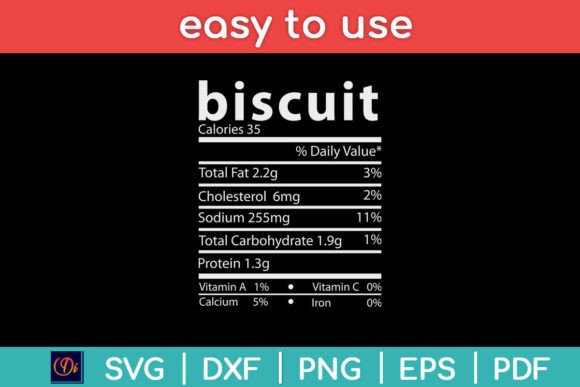
Biscuit Nutrition Facts Funny Thanks Review
As a designer who has spent years translating digital concepts into tangible stitched goods, I approach every new asset with a critical eye. The market is flooded with generic holiday graphics, but Biscuit Nutrition Facts Funny Thanks immediately caught my attention for its specific blend of humor and seasonal charm. Before I commit this design to a client project or add it to my shop's inventory, I need to understand how it translates from a screen to fabric. This isn't just about whether the image looks good; it is about how it performs under the tension of an embroidery machine and how it resonates with customers looking for that perfect handmade touch.
The Visual Personality and First Impressions
At first glance, Biscuit Nutrition Facts Funny Thanks offers a delightful narrative. The concept mimics a standard nutrition label but applies it to a beloved Thanksgiving staple: the biscuit. For those of us in the Crafts space, we know that relatable humor sells. It creates an instant connection with the buyer. The layout is structured, relying on the familiar grid of a facts panel, which gives it a clean, organized aesthetic despite the playful content. As a Graphics file intended for cutting machines like Cricut and Silhouette, the lines are sharp, but when I visualize this as a machine embroidery design, I am thinking about how those lines will be filled with thread.
The mood is lighthearted and festive without being overly cluttered. It feels like a design meant for a kitchen apron, a cozy sweatshirt, or perhaps a personalized tote bag for a holiday gathering. The visual weight is balanced, which is crucial for embroidery. If a design is too top-heavy, it can distort on curved surfaces like caps. Here, the text and the graphic elements seem evenly distributed, suggesting it will stitch out cleanly without pulling the fabric excessively.
Real-World Application: The Holiday Apron Scenario
To truly evaluate this asset, let's imagine a real-life scenario. I am preparing a batch of custom embroidered aprons for a local boutique's holiday collection. The target audience is home cooks who love to joke about their indulgence during the holidays. I envision Biscuit Nutrition Facts Funny Thanks placed prominently on the chest pocket area of a heavy-duty canvas apron.
In this context, the design shines. The sturdy canvas provides a stable base for the stitching, allowing the details of the "nutrition facts" to pop. I would likely use a high-quality polyester thread in a warm golden-brown to mimic the biscuit color, with black or dark grey for the text to ensure readability. The fill stitch areas would need to be dense enough to cover the fabric but not so thick that they create a hard lump against the wearer's body. When a customer sees this finished product, they aren't just buying an apron; they are buying a conversation starter. It adds significant value to the handmade product by infusing personality into a functional item.
Technical Considerations for Embroidery Designers
While the original description notes this is a print cut file compatible with cutting machines, many designers convert these vector shapes into embroidery files. If you plan to do this conversion or purchase a digitized version, there are specific technical hurdles to clear. The small text within a nutrition label format is often the enemy of embroidery. Tiny lettering can easily become illegible if the stitch density is too high or if the font size is pushed below a certain threshold.
Before running this on your production run, you must test the design on scrap fabric. Check the hoop size requirements carefully. A full nutrition label might require a 5x7 or even a larger hoop depending on the scaling. If you are attempting to fit this onto a smaller surface, such as a baby onesie or a cap, you may need to simplify the design. You cannot simply shrink a complex digital embroidery file without risking thread bunching and broken needles. In those cases, consider using a simplified version where only the headline and the biscuit icon are stitched, perhaps utilizing a satin stitch for the outlines to give it a polished look.
Fabric Texture and Stabilizer Needs
The success of Biscuit Nutrition Facts Funny Thanks heavily depends on the substrate. On smooth cotton t-shirts, the design should perform beautifully. However, if you are working with textured fabrics like fleece for a sweatshirt embroidery project or a knitted blanket, you will need to adjust your stabilizer strategy. A tear-away stabilizer might suffice for woven fabrics, but a cut-away or water-soluble stabilizer is essential for stretchy materials to prevent the stitches from distorting over time.
Dark fabrics present another challenge. The white background of a nutrition label needs to be opaque. You might need to apply a layer of underlay or use a specialized backing technique to ensure the colors remain vibrant. Always compare light and dark fabric backgrounds in your planning phase. A design that looks crisp on white might get lost on charcoal grey without proper contrast adjustments in your thread colors.
Commercial Viability and Brand Consistency
For the Etsy seller or the owner of a small craft business, this design offers excellent potential for holiday sales. It fits perfectly into the category of holiday embroidery gifts. However, before listing items featuring Biscuit Nutrition Facts Funny Thanks, you must confirm the licensing terms. Just because a file is available for download does not mean you have the right to sell the finished goods or the digital file itself. Many design assets come with restrictions on commercial use.
If you are creating a line of personalized gifts, this design allows for customization. You could tweak the "Calories" section to say something specific about a family member, turning a generic graphic into a bespoke piece. This level of personalization increases customer trust and engagement. It shows that you, the maker, care about the details and the story behind the product.
Final Verdict for the Makers
Biscuit Nutrition Facts Funny Thanks is a strong contender for your holiday collection, provided you respect the technical limitations of embroidery. It is not a design to be rushed. Take the time to digitize it properly, ensuring the text remains legible and the stitch count is optimized for your specific machine. Test it on different fabrics, from the rugged canvas of a tote bag to the soft jersey of a baby outfit. When executed correctly, it transforms a simple garment into a memorable keepsake.
Whether you are producing a single custom apparel item for a friend or launching a small shop product line, the key is preparation. Use proper stabilizers, check your thread colors for contrast, and always review the final result in a printable mockup before committing to expensive materials. With careful execution, this funny, festive design will undoubtedly become a favorite in your portfolio of finished products.